Lift stations are an integral part of a gravity-flow sewer system. As waste is discharged into the sewer lines, it flows downhill toward a sewer treatment plant. Ideally, all homes or developed properties would be built below the existing sewer line so gravity could do its job without help, but in reality, it just isn't possible. Lift stations allow properties to be developed further away from the city's main sewer line, but gives them the ability to connect to the existing sewer framework. A lift station is essentially an elevator for waste.
Two components make up a lift station: the wet well and the pump system. A wet well is a large, circular, underground holding tank (most commonly made of cement, but occasionally composed of steel or fiberglass) that waste drains into. After the sewage reaches a certain height in the well, a series of low-voltage floats triggers a pump, telling it when to turn on and when to stop pumping—once enough wastewater has been diverted to the main sewer line. (This process is similar to the float system used in the back of a toilet.)
If they are filled exclusively with "sanitary" waste, lift stations need very little maintenance. Problems arise when excessive grease and heavy debris find their way into the wet well. These FOG materials build up on pumps, chains, floats, and sidewalls, and will clog or damage the pump impellers, making it difficult to move waste through the sewer line. When left untreated, grease will form a solid layer across the top of the well, which prevents the lift station from pumping any waste to the main sewer line. This leads to an eventual wet-well overflow of raw sewage, which is difficult to contain and eliminate, not to mention dangerous to the environment.
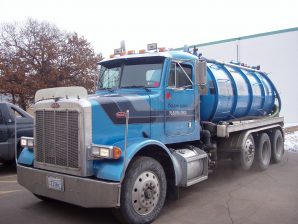
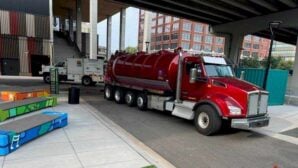
The professional at Drain King begin a through lift-station cleaning by liquefying any solid grease so it is easier to pump out. We then pump out the well using a sanitary vacuum truck, and all of the floats, impellers, and well walls are pressure-washed and thoroughly cleaned. Any solid debris left on the bottom of the tank is removed. Then, we test the entire system to ensure each part is in good working condition. Because a wet well is considered a confined space, special labor-safety regulations are in place to make entry as safe as possible. Because of the potential hazards that can arise from a confined space, only specially trained workers should attempt to enter them. Drain King’s experts have received extensive instruction in confined-space protocols. We are a safe, reliable choice for all of your drain service needs.
Lift stations are not something a homeowner or business owner thinks about until something goes wrong. A lift station is used to pump wastewater or sewage from a low level to a higher level when the gradient of the area does not allow for a natural flow.
There are two main elements to a lift station: the wet well and the controls. The wet well is a basin into which the inflow is discharged and where the pumps sit. The control panel is the brain of the lift station.
So, how do lift stations work? Sewage is stored and fed into a pit. Once this sewage reaches a certain level, electrical instruments recognize the pit is full and activate the pump, which will then pump the sewage out to its next destination. Most lift stations are housed underground to prevent health risks in a confined area, since the sewage can release poisonous gases like methane and hydrogen sulfide. Therefore, it is essential that owners of existing lift stations consult a professional like Drain King to ensure the pump is still working sufficiently.
A professional can also ensure proper maintenance of your lift station. The pumps, electronic controls, and electrical system are all in a constant corrosive environment, so lift stations require maintenance to head off the need for costly repairs.
Proper maintenance includes wet wells being pumped out and cleaned to prevent solids and grease buildup, inspection of the pumps, greasing of the check valves, and inspections and cleaning of the floats to assure proper performance. Also included is an inspection of all electrical motor-control equipment and of the basin, clean-outs, and covers to prevent buildup.
A lift station is used to pump waste water or sewage from a low level to a higher level when the gradient of the area does not allow for a natural flow. Lift stations offer a cheaper solution for companies that need to ensure removal of waste on a tight budget. Residential properties can also benefit from lift stations.
How do lift stations work? Sewage is stored and fed into a pit. Once this sewage reaches a certain level, electrical instrumentation recognises the pit is becoming full and activates the pump, which will then pump the sewage out to its next destination. Depending on demand, there can be one or more pumps used at any given time. The sewage will then go through a cleaning system to ensure that it can be reused as drinking water.
Most lift stations are housed underground to prevent health risks from the sewage. The station is placed in a confined area, since the sewage can release poisonous gases like methane and hydrogen sulphide. Therefore, it is essential that owners of existing lift stations consult a professional like Drain King to ensure the pump is still working sufficiently.
Should you decide that a new lift station is for you, we can advise on the best system to meet your needs. We can also carry out routine preventive maintenance, repair, and replacement for your already installed lift station.
Sewage lift stations, also known as pump stations, are used to move the sewage water from an area of low elevation to higher elevation, against gravity, for a continuous flow. It is also used in areas where gravity conveyance might result in additional construction costs. Sewage lift stations become economical in instances where the sewage has to be lifted over a ridge and then left to flow by gravity to the treatment facility.
Technician working on a basement lift station.
The main part of a lift station is a “wet-well.” It is waste water receiving well, where sewage is fed into and stored temporarily. The well also comes with proper equipment to detect the level of sewage present. A predetermined level is set and once sewage in the well reaches this point, a lift-pump will help lift it through a pressurized pipe system. This pipe system is called “sewer force main” or “rising main.” Sewage is then discharged into a manhole that will use the flow of gravity to transfer the contents to a treatment plant.
More than one pump or one lift station might be used to empty the well based on the volume of its contents. If it’s not emptied, then a backup in the sewer system may occur, leading to discharge of said sewage into the environment. Another importance of having more than one pump is to avoid sewage standing stagnant in the well when one of the pumps fails.
A well-designed and maintained wet well is crucial, as this ensures the smoothest operation of the lift station. Wet wells allow the automatic operation of the lift station with a simple control. The wet well should be an ideal size and not allow large volumes of stagnant sewage to collect in it, eliminating septic action. It should not wear the pumps out with constant starting and stopping. Submersible lift stations are ideal and they can function with little maintenance and are also inconspicuous.
The interior of a sewage pump station is hazardous due to the poisonous sewer gasses that accumulate. Professional personnel are trained to maintain or fix problems with lift stations. Please contact Drain King today if you are in need of a lift station installation or for maintenance and repairs. We are local experts who can take care of your needs efficiently.
Search Our Resources
DRAIN KING, INC.
Toll Free: 888-391-6241
Office: 763-786-3000
Fax: 763-571-7738