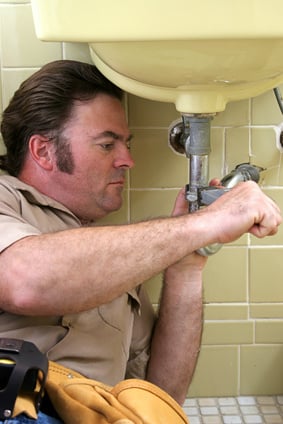
Does your home or office suffer from noisy pipes? While different noises can come from your drain service system, and no system will ever be completely silent, if you mainly hear the sound when you turn on the water, the pipes are probably loose somewhere and hitting against something.
Banging pipes are much easier to fix when they are visible, but in most cases pipes are located in the walls. To find the source of the noise, you should follow these steps.
Go to each faucet, turn on the water and look for any movement or shaking. If you find movement, place padding or foam insulation at each end where the pipe comes out of the wall or goes under the home or business. This added insulation should stop the noise.
Unfortunately, the noise may continue, and you may need to go under the house or access pipes behind walls. You may need to examine them to make sure the U-clamp, or strap holding the pipe, is not loose, allowing the pipe to hit the wall.
To eliminate the noise, you will need to strap the pipe back down and add some insulation between the wall and the pipe. This can include a piece of rubber, foam, or anything that will not wear down with the movement of the pipe when the water is turned on.
As you anchor or strap your pipes down, it is important to remember to allow for some movement. Pressure and temperature changes will cause pipes to expand and contract, and you do not want to cause a pipe to break because it is secured too tightly.
Should the knocking sound only happen when you turn on the hot water, then you only need to turn down your hot water heater, as it is set too high.
Additionally, if the banging sound is happening at an older home or business, check to make sure you have a water-pressure regulator and make sure your water pressure is not set too high. High water pressure is wasteful and can also cause damage to your appliances, including dishwashers, icemakers, washing machines, and other water-supplied appliances.
If problems persist after you’ve taken these steps, contact Drain King for assistance.
Water is our most precious natural resource. Animals and plants alike depend on its nourishment to live, as all living things are composed mostly of this vital element. Our planet is also 71 percent water, which seems like an immense amount, and it is. However, it is crucial to remember that the Earth’s water is a finite resource. Not all of the water on Earth is considered usable, as a lot of it is salt water, and smaller amounts are present as vapor in the air or moisture in the soil.
As we are so dependent on this resource, it makes sense to use it as sparingly as possible in our day-to-day living. With 7 billion people on the planet, all equally dependent on available water sources, it is time to get creative and really start paying attention to the amount of water we use…and how to use less.
The average American goes through 80 to 100 gallons of water per day. This number includes everything from washing clothes to drinking a glass of water. North America, Canada, and Australia have about the same water usage per capita, which amounts to a range of 1,037 to 5,375 gallons annually. Granted, this is a large range and a fluctuating one, but the fact remains; a lot of water is being used per person. We could easily decrease those numbers by changing the way we operate each day in our households and offices.
Some great ways to save water include swapping out showerheads, toilets, dishwashers, and faucets for newer models fitted with low-flow capabilities, most of which cut water usage in half. Replacing any of these would lower monthly costs, as well as ease the conscience.
When making the switch to a low-flow faucet or appliance, it is always a good idea to have your drain service lines checked to make sure they are free of debris and potential blockage. These could slow or stop the flow of water, ultimately making you regret the change to low flow in your home or office.
Small changes do make a difference in the impact we have on the planet, and when it's as easy as switching out a few everyday appliances in the home, why not do our part? If you are considering switching to low flow fixtures, contact Drain King for an assessment of your water lines today.
Clogged drains, pipes, or sewers can be caused by a number of factors. These can include excess debris, overgrown roots, waste blockage, sediment build-up, or grease clogs, to name a few. In order to effectively clear a clogged drain/pipe/sewer, sometimes our professionals need to have a good idea of the cause of blockage this helps them employ correct, appropriate methods.
To properly diagnose and treat a drain clog, we use state-of-the-art, video inspection technology. By inserting a small camera into the blocked area of the drain, which allows for real-time visual inspection, our professionals can determine the cause and location of the blockage. This in turns helps them pinpoint the most effective solution to clear it up.
The technician inserts a high-resolution digital camera attached to a flexible fiber-optic cable down the pipes or drains. This tool is also equipped with powerful lights, enabling the inspection of the inside of the pipes. The video camera utilizes an infrared lighting system that contains a small transmitter. It is also attached to a screen or monitor for real-time visualization that can also be recorded. This footage shows the technician exactly where excavation is required, locating the problem in the drain line and confirming the interior condition of the line.
These cameras are capable of traveling up to 1,000 feet inside any pipe from 6 to 30 inches in diameter and inspecting any portion of the pipe, using tilt and pan technology. This innovation greatly increases productivity and helps in performing repairs or clearing up clogs in an efficient manner, saving time, effort and money.
For more information about our professional video camera technology, please feel free to contact us at Drain King today. We would be happy to provide you with a free quote on our services.
Overpowering and unpleasant sewer smell inside the house can be the result of numerous failures. The sewage disposal system depends on other systems like drain service, vent and trap systems in order to function correctly.
Smelly Odor in Home
Sewage waste, when degraded by bacteria (which has a vile odor of its own, as well), releases various pungent gases like methane and hydrogen sulfide. In addition to the strong offensive odor, these gases can be combustible and hazardous.
The possible causes include:
Incorrect or a lack of vents in the traps - Vents on a drain let the sewer gases exit the drain system without coming into the house through drain service fixtures while the traps form an airlock seal against sewer gases that prevent them from entering the home.
A clogged drain – doesn't allow the odors to get to the vents, which will force them into your home.
Improperly assembled toilet - broken seals around the toilet that allow water to leak or dry out the traps which will cause the odor. An airtight seal between the toilet and floor is absolutely vital in preventing sewer smell from coming indoors. Old, rotting or damp wood can also be blamed.
Leaky, faulty pipes, especially if they are old cast iron – Gasses can collect inside the pipes and escape into the house.
Low water level in the toilet – is another possible cause especially in toilets that don’t get used often.
These are just a few reasons why you may be smelling sewer inside the house. Please contact us at Drain King, where our professionals can determine the exact cause of the sewer smell and eliminate it. It is important to note that sewer smells are dangerous. You and your family should not be exposed to them for long periods of time.
The winter holidays are full of visiting friends and relatives. Parties, dinners, gift exchanges and game nights are just a few of the many reasons people get together. With all the extra guests in your home increasing sink, shower, and toilet usage, it's a good time to take some simple steps to avoid a Griswold-style drain service catastrophe. Nothing screams disaster like a porta-potty in the front yard!
The most important thing you can do to prevent drains clogging is to make sure they are working correctly before the holidays begin. If you notice a sluggish drain, take the necessary steps to unclog it. If your toilet isn't flushing properly, have it checked. These aren't issues that will be fixed with increased usage. In fact, the opposite is true: The more guests you welcome, the more you are overwhelming an already-burdened drain service system.
Be careful about what you put in your kitchen sink. Never dump fats or cooking oils down the drain; they will solidify in the pipe and cause a blockage. If congealed grease is left in a pan, wipe it out with a paper towel and throw it away. Avoid putting stringy, fibrous, starchy, or hard-to-grind foods in the garbage disposal. (These types of food include celery, pumpkin, banana peels, poultry skins, and carrot and potato peelings.) They can wrap around the blades and keep the motor from turning. Run cold water for at least 15 seconds before and after you turn on the disposal, and always make sure the disposal is running before you add food scraps. Scraping plates into the garbage instead of the sink will save your disposal and dishwasher from potential clogs. And finally, run the dishwasher at night so there will be plenty of hot water for showers in the morning.
In the bathroom, use a shower drain screen to help filter hair and clumps of soap that are notorious for clogging pipes, and be sure to clean it out between showers. Make sure there is a lined wastebasket near the toilet to hold unflushables like sanitary pads, cotton balls, baby wipes, Q-tips, and facial tissue. Nothing should ever go into a toilet except human waste and toilet paper. Follow the 10/10 rule: Keep showers to 10 minutes or less, and wait 10 minutes between each shower so the hot water can replenish itself.
If you find yourself with a drain emergency, the most important thing is to call Drain King right away. We are available 24/7 service emergencies.
Things happen and drains get clogged, usually it is nobody’s fault. Pipes also have a tendency to clog more frequently when they are not used regularly, using a pipe only occasionally will allow the contents to settle and sometimes will create a clog. Pipes aren’t normally blocked with frequent use, as they are designed to handle high volumes. There are periods when they will slow to the point that water can hardly go through.
What should you do when this happens? When your pipes get clogged, employ a drain-cleaning technician quick! Yes, there are DIY solutions you can try before contacting a professional, but why risk making a costly mistake?
There are items that can be used as a fast fix, but the remedy they offer is generally short-term. You can reduce the blockage, but there’s still a chance you’ll experience it again. This is why it’s better to call in a drain-cleaning technician get rid of the obstructions completely. Aside from eliminating the clog, a professional technician will also make sure that the pipes are in good working order.
You don’t have to fear spending more than what you would would likely spend on home remedies; the price is really worth it. One big benefit of asking a professional to empty your pipes is having the right resources to do it securely and mess-free. How many times have you seen DIY block elimination gone badly? You simply can’t risk damaging other items in your kitchen due to poor cleaning techniques. Drain Service technicians are prepared to deal with these circumstances, so it’s always a good idea to rely on a professional.



 Water is our most precious natural resource. Animals and plants alike depend on its nourishment to live, as all living things are composed mostly of this vital element. Our planet is also 71 percent water, which seems like an immense amount, and it is. However, it is crucial to remember that the Earth’s water is a finite resource. Not all of the water on Earth is considered usable, as a lot of it is salt water, and smaller amounts are present as vapor in the air or moisture in the soil.