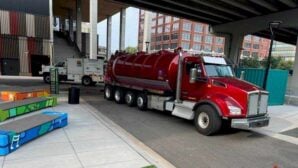
Sewage lift stations, also known as pump stations, are used to move the sewage water from an area of low elevation to higher elevation, against gravity, for a continuous flow. It is also used in areas where gravity conveyance might result in additional construction costs. Sewage lift stations become economical in instances where the sewage has to be lifted over a ridge and then left to flow by gravity to the treatment facility.
Plumber working on a basement lift station.
The main part of a lift station is a “wet-well.” It is waste water receiving well, where sewage is fed into and stored temporarily. The well also comes with proper equipment to detect the level of sewage present. A predetermined level is set and once sewage in the well reaches this point, a lift-pump will help lift it through a pressurized pipe system. This pipe system is called “sewer force main” or “rising main.” Sewage is then discharged into a manhole that will use the flow of gravity to transfer the contents to a treatment plant.
More than one pump or one lift station might be used to empty the well based on the volume of its contents. If it’s not emptied, then a backup in the sewer system may occur, leading to discharge of said sewage into the environment. Another importance of having more than one pump is to avoid sewage standing stagnant in the well when one of the pumps fails.
A well-designed and maintained wet well is crucial, as this ensures the smoothest operation of the lift station. Wet wells allow the automatic operation of the lift station with a simple control. The wet well should be an ideal size and not allow large volumes of stagnant sewage to collect in it, eliminating septic action. It should not wear the pumps out with constant starting and stopping. Submersible lift stations are ideal and they can function with little maintenance and are also inconspicuous.
The interior of a sewage pump station is hazardous due to the poisonous sewer gasses that accumulate. Professional personnel are trained to maintain or fix problems with lift stations. Please contact Drain King today if you are in need of a lift station installation or for maintenance and repairs. We are local experts who can take care of your needs efficiently.
Water is a unique liquid as it expands when it freezes (as in ice). Therefore, plastic or metal pipes that contain water are under tremendous pressure when this occurs in colder weather. This can cause even the best-made pipes to break or crack. Pipes that are susceptible to this are located in areas like swimming-pool supply lines, water-sprinkler lines and water-supply pipes in unheated interior areas like basements and crawl spaces, attics, garages or kitchen cabinets. Also, pipes that run against exterior walls that have little or no insulation are also vulnerable to breakage or cracking.
Even before the onset of the cold weather months, pipe freezing can be prevented by draining water from swimming-pool and water-sprinkler supply lines. Antifreeze should not be used in these lines unless directed. Antifreeze is environmentally harmful, and is dangerous to humans, pets, wildlife and landscaping. Hot- and cold-water pipes in areas with no heat should be insulated. Products such as pipe sleeve, or installing heat tape or heat cable, can be used to insulate water pipes. If on a budget, newspaper can provide some degree of insulation and protection to exposed pipes.
During the cold-weather months, allowing warm air to circulate around plumbing can help keep pipes from freezing. If exposed pipes have faucets attached, a trickle of cold water dripping from them will help prevent the pipes from freezing.
If the pipes have already frozen, thawing them is necessary. Faucets with frozen pipes should be kept open. As frozen pipes are treated, running water through the pipe will help melt any ice. Applying constant heat in the form of a heating pad wrapped around the pipe, a hair dryer or space heater, or wrapping pipes with cloths soaked in hot water will help thaw them. Careful care should be taken to avoid using open-flame devices.
Sometimes if one pipe is frozen, additional pipes may freeze, as well. Hence, all the faucets must be checked. In cases where the frozen area of the pipe is not known or not accessible, a licensed professional’s help must be sought. Call us today at Drain King if you experience any problems with frozen pipes this winter. We are your local experts and will take care of all your needs in an efficient and professional manner.