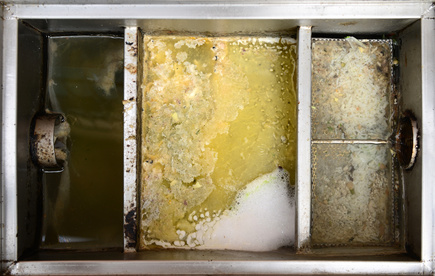
A grease trap is a necessity in any commercial kitchen, large or small. Typically, smaller kitchens will have a grease trap inside, while larger facilities house them outside. Grease traps slow the flow of water coming from drains, giving the grease time to cool. This cooling causes the grease to coagulate and float to the top, while heavier solids fall to the bottom of the trap. The remaining water is free to pass through into the city sewer lines.
Proper maintenance is crucial to effective grease trap operation and to keeping your business running and up to city code. Drain king’s professional technicians should be contracted to maintain grease traps before any problems occur. If the levels of collected fats, oils, and grease (FOG) and solids are not monitored, problems such as drain-line blockages, backups, or foul odors can occur. This can lead to too much FOG being deposited into city sewer lines. This city code violation could result in a fine for the business, as well as necessitate an emergency call to a professional technician to clean out the grease trap and pump the lines.
Our technicians will keep records of when maintenance procedures are done, such as pump outs, cleanouts, or when bacteria is added. Having a professional care for your grease trap gives you piece of mind. Drain King offers frequent-customer plans or preferred-customer programs that provide you emergency services and routine scheduled maintenance.
When it comes to sewer line inspection, we keep up on all of the latest technologies. Drain King Inc can help you find your sewer problem quickly! In the past, if you had a problem with your sewer, the cause was identified and corrected through a lot of expensive, messy, guesswork and large-scale yard excavation. There was no way to tell, with any certainty, where the sewer line failure occurred. So they would have to start cutting away sections of sewer pipe to pinpoint the trouble areas. Sometimes they made good guesses and the problem was easily fixed, and other times the yard became a nightmare of trenches, tracks and mounds of dirt unearthed leaving YOU to re-sod almost everything! This approach was both inefficient and costly.
Fortunately for today's home or business owner, sewer disruptions are now much faster, easier, and less expensive to diagnose and correct. Our Drain King professionals utilize state-of-the-art equipment that allows us to locate and inspect sewer and drain lines without having to dig up your entire yard. We use high definition cameras to give us detailed information about the condition of sewer pipes and where the obstacle (or obstacles) are located. We can map the location and depth of your sewer line to prevent accidental damage when digging for landscape or construction purposes.
Here's how sewer line inspection works: Our high-tech miniature cameras are mounted to the end of a fiber-optic cable, which is then pushed into a sewer line. The camera is controlled by a
We Recovered a Wedding Ring!
certified Drain King technician, who can change its speed, direction, and angle of inspection. A digital recording is made of the camera's progression through the sewer pipes, which shows our expert what sort of impediment is interfering with the sewer line. (SIDE NOTE: We actually retrieved a diamond wedding ring for one of our clients!) We can detect whether roots have grown into the sewer line, identify a buildup of food or kitchen grease in the pipe, identify foreign objects that have been flushed down the toilet, and check for natural deterioration of sewer and water lines. The obstacle can be removed or the sewer line can be repaired at the exact spot it is impaired, without having to dig up large areas of your yard.
Our sewer line inspection services employ similar techniques with a transmitter and a hand-held receiver. We can push a transmitter through a sewer line as narrow as 1 1/2 inches, and locate it with an above-ground receiver. This gives us the exact depth and location of your sewer pipes, as well as the direction they run. Having this information is critical in the early planning stages of landscaping or remodeling. Without knowing exactly where your sewer pipes are located, you run the risk of unintentionally damaging them or unnecessarily tunneling through your yard to find them.
Whether you're dealing with a sewer line emergency or planning a home renovation, let the experts at Drain King locate your sewer lines efficiently and accurately with our leading-edge Sewer Line Inspection services.
Preventative maintenance for commercial drains is a no-brainer! Most issues can be avoided with a simple phone call to a professional drain cleaning company before a sewer or grease trap backup occurs.
Key Considerations When Choosing a Commercial Drain Cleaning Company:
Experience Matters: Look for a company with substantial experience in commercial drain cleaning. Their expertise is crucial for advising you on the right preventative maintenance plan and ensuring timely, effective service.
Proper Equipment: Ensure the company has the right equipment. Many residential drain cleaning companies use smaller tools that may not be powerful enough for the larger drains typical in commercial settings. Here at Drain King, we have crews set up for both situations.
Budgeting for Maintenance: Incorporating a commercial drain cleaning preventative maintenance program into your yearly business budget is essential. This proactive approach helps prevent issues before they arise, protecting your business from flooding and costly shutdowns.
Why Choose Us?
Expert Advice: Our experienced team will guide you in creating the best maintenance plan for your needs. Comprehensive Services: We have the right tools and expertise to handle all aspects of commercial drain cleaning.
Contact us today to set up your preventative maintenance plan and keep your business running smoothly!
We provide several services to assist customers and companies with sewer system repair and maintenance. But what is a commercial sewer system and how does it work?
A sewer system is comprised of a centralized network of pipes that collect both wastewater and stormwater from multiple sources and transports it to a sewer facility for treatment or disposal. Urban sewer systems are typically one of two types: 1) a combined system, in which both sanitary wastewater (comprised of liquid and waterborne wastes) and stormwater share the same pipeline, or 2) a separate system, where wastewater and stormwater travels in separate pipelines, called the storm sewer.
Ideally, a sewer system is gravity-powered. Drainage pipes from each building (i.e. residences, commercial buildings, industrial complexes, etc.) flow to a sewer main that runs down the middle of the street. The sewer mains flow into the treatment plant, which is usually located in a low-lying area. Once there, the water goes through one, two, or three stages of treatment, depending on the capabilities of the plant.
The first stage is called Primary Treatment. Holding pools allow waste solids to settle and the scum to rise. The system then collects the solids for disposal. If this is the only stage of treatment, the water is chlorinated to kill the remaining bacteria before it's discharged.
The second stage, called Secondary Treatment, uses bacteria in large, aerated tanks to remove organic materials and nutrients from the wastewater, which then flows to settling tanks, where the bacteria settle out. This treatment removes up to 90 percent of all solids and organic materials from the wastewater.
The third stage, Tertiary Treatment, can vary, depending on the community and the composition of the wastewater. Typically, chemicals are used to remove phosphorous and nitrogen from the water, but filter beds may also be used. Any remaining bacteria are killed by adding chlorine, and the wastewater is discharged.
While many commercial businesses can connect to a centralized sewer line provided by local governments or private corporations, the regulation and requirements are different in every city. Businesses are typically charged for usage based on the amount and content of the wastewater that is processed. For example, restaurants require systems that are capable of managing oils, fats, greasy substances, and food items. Fats, oils, and grease (FOG) are one of the leading causes of sewer overflows and maintenance concerns in sewer systems across the United States, and must be carefully monitored and controlled.
For areas without an existing sewer system, establishing centralized sewer services can draw businesses to the community and promote commercial growth. Without a system in place, businesses are forced to rely on in-ground septic tanks, a type of onsite sewage facility. Wastewater is collected and stored in a holding tank that is installed on the property. Regular preventative maintenance is required to remove solids that settle at the bottom of the tank, which often becomes the responsibility of the resident or property owner. If neglected, septic systems can pose a variety of problems for the owner. They can also cause pollution levels to exceed acceptable limits, harming plant and animal life.
Sewage lift stations, also known as pump stations, are used to move the sewage water from an area of low elevation to higher elevation, against gravity, for a continuous flow. It is also used in areas where gravity conveyance might result in additional construction costs. Sewage lift stations become economical in instances where the sewage has to be lifted over a ridge and then left to flow by gravity to the treatment facility.
Technician working on a basement lift station.
The main part of a lift station is a “wet-well.” It is waste water receiving well, where sewage is fed into and stored temporarily. The well also comes with proper equipment to detect the level of sewage present. A predetermined level is set and once sewage in the well reaches this point, a lift-pump will help lift it through a pressurized pipe system. This pipe system is called “sewer force main” or “rising main.” Sewage is then discharged into a manhole that will use the flow of gravity to transfer the contents to a treatment plant.
More than one pump or one lift station might be used to empty the well based on the volume of its contents. If it’s not emptied, then a backup in the sewer system may occur, leading to discharge of said sewage into the environment. Another importance of having more than one pump is to avoid sewage standing stagnant in the well when one of the pumps fails.
A well-designed and maintained wet well is crucial, as this ensures the smoothest operation of the lift station. Wet wells allow the automatic operation of the lift station with a simple control. The wet well should be an ideal size and not allow large volumes of stagnant sewage to collect in it, eliminating septic action. It should not wear the pumps out with constant starting and stopping. Submersible lift stations are ideal and they can function with little maintenance and are also inconspicuous.
The interior of a sewage pump station is hazardous due to the poisonous sewer gasses that accumulate. Professional personnel are trained to maintain or fix problems with lift stations. Please contact Drain King today if you are in need of a lift station installation or for maintenance and repairs. We are local experts who can take care of your needs efficiently.