A back-up of your sewer system can be a costly and damaging event. Knowing the signs of a clogged drain line or sewer system can help you avoid having to go through such a mess. A clogged sewer line will usually offer clues before it backs up completely. The most common signs of a clogged line are sounds that come from drains and toilets, water backing up or pooling around the drains or toilets, and the smell of raw sewage coming from your drains. If you have an older home or several trees on your property, routine maintenance of your drain system may be the best way to keep your pipes running smoothly.
Most clogs can be cleared quickly. A Drain King professional will typically run a cable, also known as a drain auger or snake, through the line to clear the clog. Clogs can occur in the main sewer line or in one of the smaller secondary lines. If the clog is in the main line, it will impact all the drain service inside your home, and any water you run will create a backup. If it is a secondary line, problems would most likely be isolated to that area.
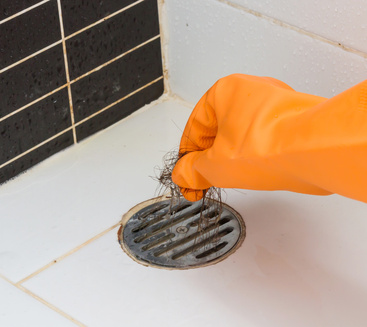
Clearing your lines with a snake or drain auger will unclog your system, but if the lines are still draining slowly it may be time to have them cleaned. A high-pressure water jet is used to remove all the residue that builds up in your lines, including grease, mineral deposits, hair, food, and other blockages.
Have you walked through your home and counted the number of drains you actually have? Probably not. So until there is a problem, most people do not think about their pipes or what is done to clean them after something goes wrong.
It takes the right skill and proper equipment to do an effective, long-lasting, and thorough drain-cleaning job. Some companies focus on a “punch-and-run” approach, in which they simply make a hole in a clog rather than clean out and flush the pipe. At Drain King, we focus on doing the job right. To us, the punch-and-run approach is only putting a Band-Aid on a problem that will return sooner than necessary. To properly clean drains, you need the right diagnoses of the problem, the proper equipment, the correct size cleaning-head attachment, and a professional who will take the proper time to make sure the drain is fully cleaned.
There is a difference between just unclogging a drain and cleaning a drain line. A good drain-cleaning professional will have a clear understanding of this and likely know the cause of any clog. If you look around your house, you’ll find a variety of different drains that need to be kept clean so they work properly. Kitchen drains, shower and bath drains, bathroom sink drains, toilet drains, and floor drains all lead to the main sewer-line drain connecting your home to the city system or your septic tank. Done correctly, a professional drain cleaning will ensure the entire system is running properly.
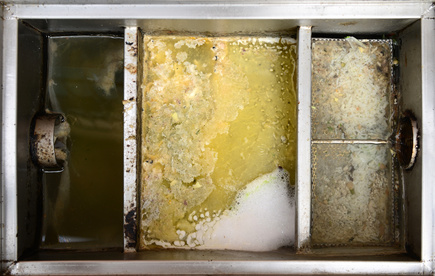
A grease trap is a necessity in any commercial kitchen, large or small. Typically, smaller kitchens will have a grease trap inside, while larger facilities house them outside. Grease traps slow the flow of water coming from drains, giving the grease time to cool. This cooling causes the grease to coagulate and float to the top, while heavier solids fall to the bottom of the trap. The remaining water is free to pass through into the city sewer lines.
Proper maintenance is crucial to effective grease trap operation and to keeping your business running and up to city code. Drain king’s professional technicians should be contracted to maintain grease traps before any problems occur. If the levels of collected fats, oils, and grease (FOG) and solids are not monitored, problems such as drain-line blockages, backups, or foul odors can occur. This can lead to too much FOG being deposited into city sewer lines. This city code violation could result in a fine for the business, as well as necessitate an emergency call to a professional technician to clean out the grease trap and pump the lines.
Our technicians will keep records of when maintenance procedures are done, such as pump outs, cleanouts, or when bacteria is added. Having a professional care for your grease trap gives you piece of mind. Drain King offers frequent-customer plans or preferred-customer programs that provide you emergency services and routine scheduled maintenance.
When it comes to sewer line inspection, we keep up on all of the latest technologies. Drain King Inc can help you find your sewer problem quickly! In the past, if you had a problem with your sewer, the cause was identified and corrected through a lot of expensive, messy, guesswork and large-scale yard excavation. There was no way to tell, with any certainty, where the sewer line failure occurred. So they would have to start cutting away sections of sewer pipe to pinpoint the trouble areas. Sometimes they made good guesses and the problem was easily fixed, and other times the yard became a nightmare of trenches, tracks and mounds of dirt unearthed leaving YOU to re-sod almost everything! This approach was both inefficient and costly.
Fortunately for today's home or business owner, sewer disruptions are now much faster, easier, and less expensive to diagnose and correct. Our Drain King professionals utilize state-of-the-art equipment that allows us to locate and inspect sewer and drain lines without having to dig up your entire yard. We use high definition cameras to give us detailed information about the condition of sewer pipes and where the obstacle (or obstacles) are located. We can map the location and depth of your sewer line to prevent accidental damage when digging for landscape or construction purposes.
Here's how sewer line inspection works: Our high-tech miniature cameras are mounted to the end of a fiber-optic cable, which is then pushed into a sewer line. The camera is controlled by a
We Recovered a Wedding Ring!
certified Drain King technician, who can change its speed, direction, and angle of inspection. A digital recording is made of the camera's progression through the sewer pipes, which shows our expert what sort of impediment is interfering with the sewer line. (SIDE NOTE: We actually retrieved a diamond wedding ring for one of our clients!) We can detect whether roots have grown into the sewer line, identify a buildup of food or kitchen grease in the pipe, identify foreign objects that have been flushed down the toilet, and check for natural deterioration of sewer and water lines. The obstacle can be removed or the sewer line can be repaired at the exact spot it is impaired, without having to dig up large areas of your yard.
Our sewer line inspection services employ similar techniques with a transmitter and a hand-held receiver. We can push a transmitter through a sewer line as narrow as 1 1/2 inches, and locate it with an above-ground receiver. This gives us the exact depth and location of your sewer pipes, as well as the direction they run. Having this information is critical in the early planning stages of landscaping or remodeling. Without knowing exactly where your sewer pipes are located, you run the risk of unintentionally damaging them or unnecessarily tunneling through your yard to find them.
Whether you're dealing with a sewer line emergency or planning a home renovation, let the experts at Drain King locate your sewer lines efficiently and accurately with our leading-edge Sewer Line Inspection services.
Have you noticed your water bill increasing, even though your usage is the same? Do some areas of your yard appear soggy or fill with standing water? Do you notice areas of damp or moldy drywall, or wet rings on the ceiling? What about bubbled or stained paint? Have you suddenly and consistently lost water pressure? Does it sound like water is running, even though each faucet is turned off? All of these signs point to a broken water pipe. Don't panic, but DO call (888-391-6241) or contact Drain King right away. We are here to help you, day or night. A speedy repair means less water damage to your property, and less money lost on increased water bills.
Finding the damaged pipe will require a thorough inspection by one of our drain service specialists. While you may be able to narrow down the whereabouts of the pipe breaks, we use a variety of methods to detect and pinpoint its exact location. One technique is Televising, in which we use a high-tech miniature camera mounted to the end of a fiber-optic cable to push through the sewer pipe and identify the precise location of the break. The sewer line can be repaired at the specific spot it is impaired, without having to dig up large areas of your lawn. A similar locating technique uses a transmitter and a hand-held receiver to send sound waves through the ground. When a transmitter is pushed through a sewer line, those sound waves are recorded by an above-ground digital receiver that shows the technician where the pipes are whole, obstructed, or broken.
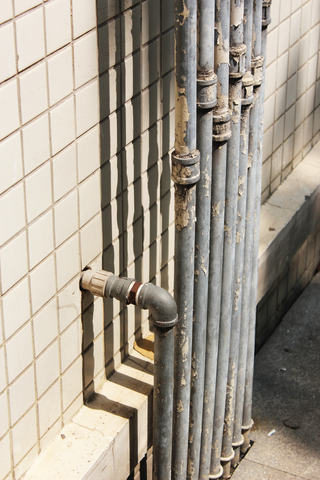
Broken water pipes are frustrating. They can happen with no warning and cause thousands of dollars in damages and repairs. Some pipes burst because they are made with old or inferior types of materials, and changing water pressures weaken the pipe wall over time. Other pipes burst because they've frozen in winter. As trapped water begins to freeze, it expands in the pipe. If the pipe has any structural weakness, that expansion causes a split or break in the water line, which may not be evident until the pipe thaws out. The easiest way to avoid this is to run a slow trickle of water from the faucet during the night, and to keep the thermostat set at a minimum of 55 degrees at all times.
Whatever the cause, Drain King is ready with a solution.